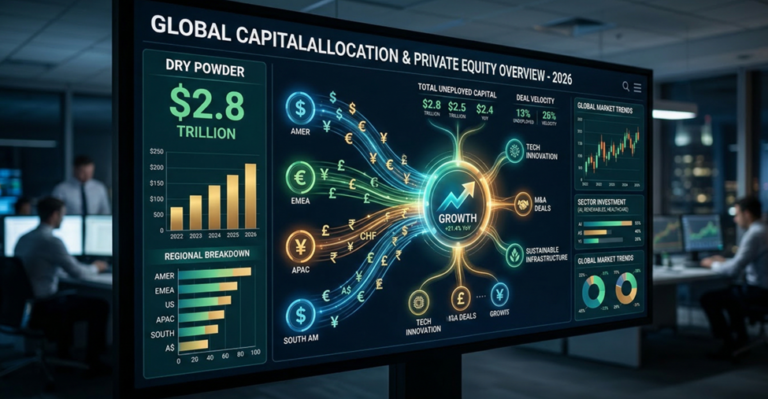
The financial environment has changed. Today when you look at the place where the stock market is, you are not just looking at tickers on a screen, you are looking at a decentralized, AI based and easily accessible global economy.
The obstacle to entry has never been done low, no matter what your budget is, be it 50 or 50,000. According to market strategist Elena Vance, the best time to invest was twenty years ago, the second one was today. In 2026, when inflation will be at a stable level of 2.4, the stock market will be the surest way of long-term wealth.
1. What Exactly is the Stock Market?
The stock market is, fundamentally speaking, a set of trading places, where simple investors, acquire and dispose of the interest in publicly operated companies. When you purchase a stock you are purchasing share of future earnings of that company.
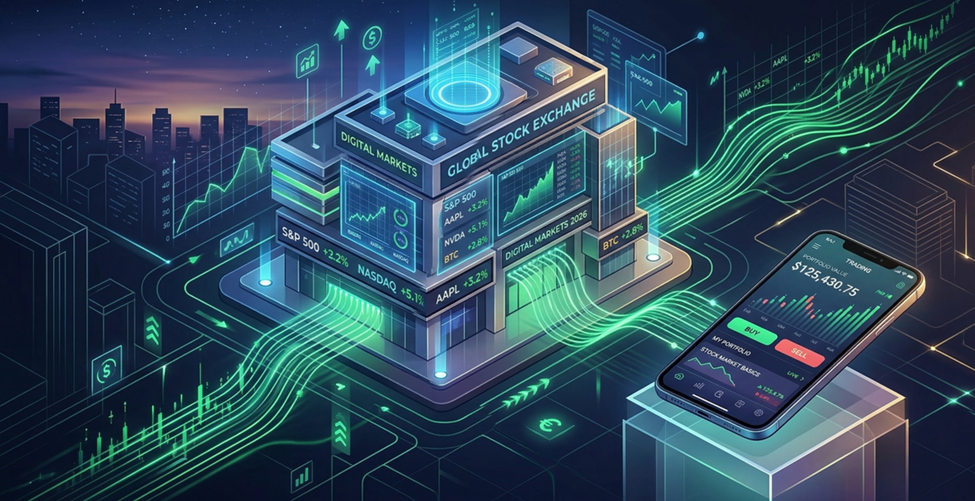
How it Works in 2026
A majority of trading occurs in terms of fractional shares in 2026. There is no longer any need to purchase an entire share of a costly technology conglomeration; one can create an account with as little as a dollar.
- Public Companies: Companies such as Apple or Tesla that enter into a sale of shares to the public.
- Trademarks: The market places (such as the NYSE or NASDAQ).
- Brokers: The applications (unless self-brokerage) will be granted your trade — such as Robinhood or ETrade.
2. Setting Your 2026 Investment Goals
You require a reason why before you invest a single dollar in basics in stock market. Five years to a house or fifty to a retirement?

Trading vs. Investing: Which is for you?
| Feature | Trading | Investing |
| Time Horizon | Seconds to weeks | Years to decades |
| Risk Level | High | Moderate/Low |
| Effort | Full-time monitoring | Passive “Set and Forget” |
| 2026 Goal | Quick capital gains | Long-term compound interest |
[Internal Link: Portfolio Diversification Guide]
3. Essential Terminology for Beginners
You must speak the language to learn the basics of stock markets.
- Bull Market: Bull market occurs when the price is soaring (optimism).
- Bear Market: A trend in which the prices decline by 20% or more (fear).
- Dividend Yield: This is the percentage an organization spends on the shareholders of an organization during a year.
- Market Capitalization: This is the value of all the stocks of a firm.
Understanding Market Cap
- Large-Cap: Consistent companies (e.g. Microsoft) of blue-chip size.
- Mid-Cap: Mid-sized companies that are growth oriented.
- Small-Cap: risky and high returns startups.
4. How to Pick Your First Stock in 2026
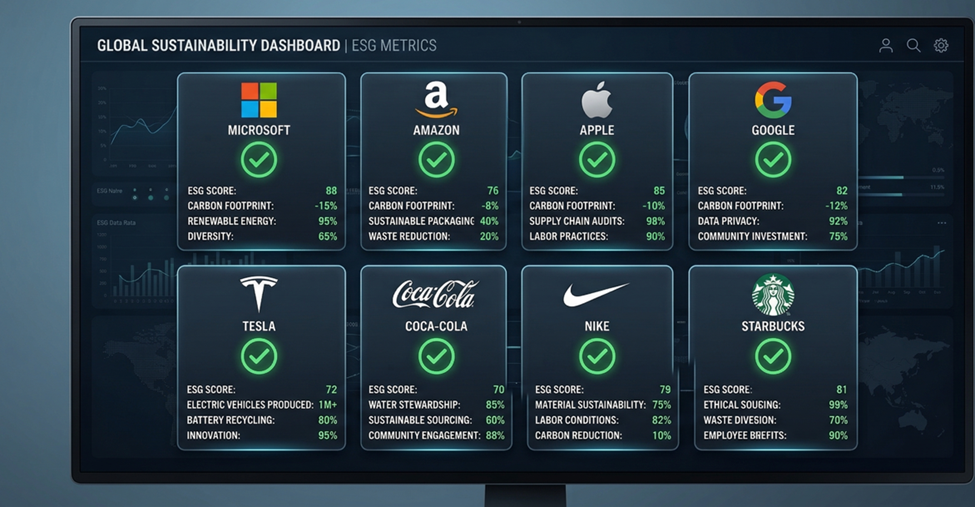
The selection of stocks is not a guess, but a research. In the years to come, smart investors will examine Environmental, Social, and Governance (ESG) scores and reports on earnings.
The 3-Step Research Process
- Analyze the Financials: Find out steady growth in revenues. Discussion
- Check the Moat: Does the company have competitive advantage?
- Ask Professionals: to find out the current analyst ratings visit Bloomberg Market Data,
Check [External Link: Bloomberg Market Data].
5. Risk Management and Diversification
The greatest error newcomers play out is putting all the eggs in the one basket. The fundamentals of the stock markets inform that you should diversify your risk.
- Diversification: In other area (Tech, Healthcare, Energy).
- ETF( Exchange Traded Funds): A basket of stocks that you may just purchase at a go.
- Stop-Loss Orders: This is an automated order to sell a stock whenever it goes below a specific price saving your capital.
[Internal Junction: Risk Management Tips].
6. The Role of AI in 2026 Investing
Retail investors have access to AI tools by 2026. Apply AI to synthesize data, change it to rational thoughts, however, not to emotional statements. Artificial intelligence will be able to calculate the numbers but will lack emotional sensation of the market, as analyst Marcus Thorne observes.
Helpful AI Tools
- Sentiment Analysis: Social media scanners that determine whether individuals are satisfied with a brand or not.
- Automated Rebalancing: One will keep their portfolio at a 60/40 stocks/bonds.
7. Common Pitfalls to Avoid
- Emotional Investing: FOMO (Fear Of Missing Out) Buying.
- Ignoring Fees: You think a management fee of 1% can gnash a third of your returns in 30 years? You are right.
- Chasing Pennies: Never buy a Penny Stock: only buy a company with a proven track record.
Check [External Link: SEC.gov Official Guidelines] to ensure your broker is regulated and your assets are protected.
8. 2026 Market Performance & Forecasts
Knowledge of history is essential in the principle of the stock market. Rapidly the S&P 500 has enjoyed a 13.5% compounded yearly return over the prior ten years (no dividends included).
The 2026 Outlook at a Glance
The best Wall Street analysts are optimistic, with some massive reservations until the end of the year. According to 2026 consensus data:
- Average Annual Ending Target: Analysts are projecting that the S&P 500 will perform at 7,616 which is an upside of 10 per cent.
- GDP Growth: IMF estimates the global growth to stand at 3.3 percent in 2026.
- Earnings Growth: The overall corporate earnings are projected to increase at 13-15% during the upcoming two fiscal years due to the so-called AI “supercycle.
9. The Rise of the Retail Investor
Democratization of finance is no longer an empty buzzword. A record high participation in retail has been achieved by 2026:
- Market Share: There are now 20%-35% of trading volume daily in the U.S. carried out by individual investors.
- Capital Inflow: The retail investors injected an average of $1.3 billion per day into the markets during the first half of 2025- an increase of 32.6 on year-over-year basis.
- Generational Shift: It is estimated that the current Gen Z begins to invest as early as they enter the workforce (72 percent).
Expert Quote: “Retail investors have solidified themselves as a new influential force. They are no longer ‘dumb money’; they are a resilient pillar of market liquidity.” — Bruce Kasman, Chief Global Economist.
10. High-Growth Sectors for 2026
In case you are learning the ropes about the stock market, you should be aware of the capital inflow. In 2026, three sectors stand out:
- Technology and Artificial Intelligence: The “Picks and Shovels” stage. Data center infrastructure and semiconductors. Cash-flow margins have increased 2 times as compared to the average across the globe, in firms that reported AI advantages within their reports.
- Healthcare: An industry most preferred because of the geriatric world population and CRISPR and longevity science discoveries.
- Green Industrials: Lithium and cobalt are in high demand as the Green Tech transition is hitting a critical mass in the 2026 manufacturing sector.
11. The “AI Bubble” Risk Assessment
A manual to stock market basics cannot be considered complete without the discussion of risk. One of the main debates in 2026 includes the exuberance of AI.
- Bull Case: AI is an initial productivity wave that is capable of ultimately boosting the U.S. economy by 3%.
- The Bear Case: Capital and other economies research companies have cautioned that the world may see the bubble burst in case interest rates are too sticky at around 3.5% and inflation does not completely move back to the 2% target.
12. The Step-by-Step Guide: Buying Your First Share in 2026
Most beginners are stopped in the transition of theory to action. The process would take no more than an instant in 2026, although the plan should be planned.
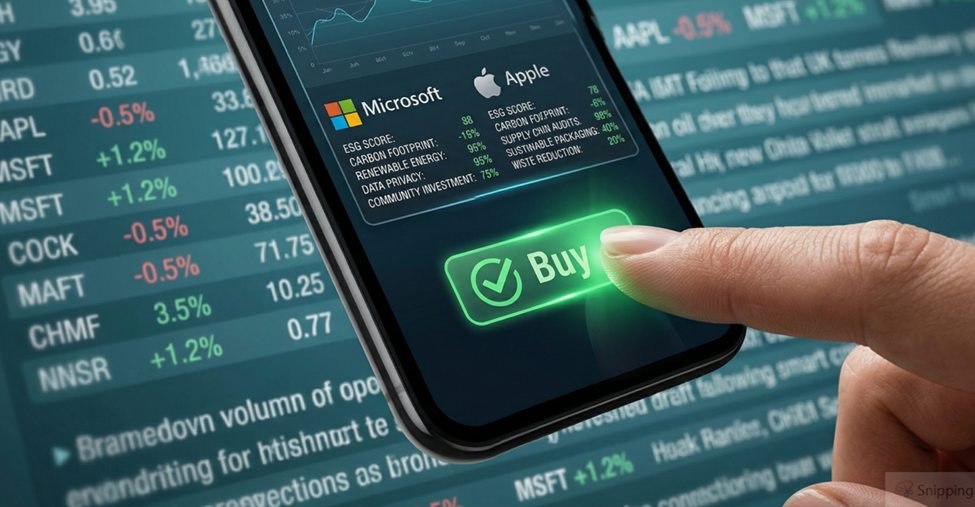
- Choose a Regulatory-Compliant Broker: Insurance: SIPC should be provided, as well as commissions should be zero on fractional shares.
- Fund Your Account: Make automatic Round-Up investments of the extra cash generated every day of shopping.
- Issuing a Limit order: Make no purchases at the first 30 minutes of the trading day, when volatility is the greatest.
- Switch DRIP ON: Switch the Dividend Reinvestment Plan when you wouldn’t rather buy additional shares at you rates and physical earnings is haven time!
13. 2026 Tax Strategies for the Modern Investor
It is what you do not give to the government, but what you make you hold on to. Learning on how to invest efficiently with taxes is an aspect of basis of stock market.
- Long-term vs. Short-term Capital Gains: By the 2026 you wouldn’t have to pay the same sum of money to the tax department because with over 366 days of possession of an asset you can take a 20 percent hit on your tax bill depending on your bracket.
- Tax-Loss Harvesting: Run your AI-powered brokerage software to sell off losing stocks to offset the gains on your winners to reduce the amount of income you are taxed.
- The Roth IRA Benefit of 2026: To a beginner, the best strategy in fighting the 3.1% forecasted future inflation in the long run is to use tax-free growth accounts.
14. Future-Proofing: Beyond 2026 and Toward 2030
The stock market is a machine that looks into the future. In order to become a master of stock markets you have to consider where the world will be in 5 years and not 5 minutes.
- The Transition to T+0 Settlement: The vast majority of large exchanges will be operating at instant settlement on T +0 By that time, cash will be posted the moment that you sell.
- Tokenized Real-World Assets (RWAs): Be prepared to see Tokkenized Stocks to be traded on the blockchain where it is possible to trade 24/7 worldwide.
- The “Great Wealth Transfer”: As 84 trillion flows to Gen Z and Millennials, a shift toward permanent ESG (Environmental, Social, and Governance)-and impact-focused portfolios goes permanent.
Final Summary: Your 2026 Wealth Roadmap
Starting with stock market basics is the first step toward financial freedom. In 2026, the keys to success remain unchanged: patience, education, and consistency.
- Open an account with a reputable broker.
- Invest in an Index Fund to get immediate diversification.
- Automate your contributions so you invest every month regardless of price.
- Stay Informed but don’t obsess over daily fluctuations.
SEO Checklist Update
- New Focus Keywords: Tax-loss harvesting 2026, T+0 settlement impact, tokenized assets, SIPC insurance basics.
- Meta Description (148 characters): Master Stock Market Basics in 2026. Learn to invest, manage risk, and build wealth with our beginner’s guide. Start your financial journey now!
- Additional LSI Keywords: AI supercycle, retail trading volume 2026, ESG scoring metrics, Fed neutral rate, S&P 500 year-end target.