The M&A Global environment: Trends, Advantages, and Global Effects has a 2026 recovery process with a K-shaped type. Although the number of deals is even, the total value has soared, as the megadeals have rebound to over 5 billion. The current change is a strategic turnaround: businesses no longer buy to scale but buy to be smart, in particular, to artificial intelligence (AI) infrastructure, cross-border resilience.
Alt-text: Two business executives are shaking hands in a high-tech boardroom as 2026 M&A trends.
The Current State of Global M&A: A 2026 Overview
By Q1 2026, the M&A market will be characterized by dichotomy between the haves and the have nots. It stated that the deal value increased by 36% in 2025, which was almost unbelievable and came to 3.52 trillion global deal value, according to [Link to External PwC 2026 M&A Outlook]. Nevertheless, the mid-market is risk-averse because of valuation differences and stricter credit review.
The Rise of the Megadeal
There were 111 deals of over five billion dollars in 2025 which is 76% higher than the year before. This capitalization shows that there are champions who are well capitalized and are utilizing M&A to drag out the competition.
The “K-Shaped” Recovery
- The Upper Arm: Tech, Energy, and Healthcare giants in search of transformational scale.
- The Lower Arm: Smaller players that have problems with high capital costs and regulatory call-in powers.
Strategic Benefits of Mergers and Acquisitions
In addition to a mere market share, the contemporary M&A offers structural benefits which organic growth frequently cannot bring in the turbulent economy.
1. Accelerating AI Integration and Capabilities
Acqui-hiring has been supplanted by system-buying in 2026. Firms are also buying AI-native firms not only due to their talent, but also due to their proprietary data moats and pre-established neural architectures.
Quote of the Expert: “By 2026, the strategic justification of M&A will not be based on the revenue addition but on the intelligence addition. — Global Tier-1 Bank Chief Strategy Officer.
2. Synergistic Value and Cost Optimization
Within the low-growth environment, the Focus Keyword in Subheadings- Mergers and Acquisitions: Trends, Benefits, and Global Impact occurs most evidently in terms of cost synergies. With consolidations of redundant back-office processes and the AI-driven supply chain, merged entities are realizing an increase in the EBITDA margin of 5 to 10 percent within 18 months after the close.
Alt-text: Pieces of a 3D puzzle that symbolise convergence in the industry, which take place during mergers and acquisitions.
Identifying 2026 M&A Trends.
The motive of deals has changed. The following are the 5 forces within the market that are transforming the market today.
The AI Infrastructure Supercycle
The estimated cost of AI data centers, semiconductors, and power generation may take between 5 trillion and 8 trillion in a period of one or five years. This has opened a flood of “convergence deals” in which tech companies acquire energy providers to have steady power to their LLM (Large Language Model) clusters.
Portfolio Simplification and Carve-outs
On the other hand, most conglomerates are dropping in size. Today, we are witnessing the highest number of divestitures in history, more than 1.6 trillion in 2025, the companies are selling off non-core assets to finance their digital transformations. [Connection with Internal Post on Divestiture Strategies].
Alt-text: Figure of financial data that represents the effects of AI on the execution of M&A deals.
Navigating the Global Impact of Mergers and Acquisitions.
These deals have become not only economical but also geopolitical in the globe.
Cross-Border Resilience
M&A across borders now take up about 30 percent of the value of the deal. Acquisitions are being used by companies to near-source their manufacturing to avoid tariff wars and disruptions in their supply chains.
The Regulatory Hurdle: Antitrust in 2026
The regulators of the US, EU, and UK have shifted to pro-growth yet greatly sovereignty-based policies.
- Sub-threshold reviews: Authorities can now examine even minor tech deals in the event that they have a fear of a killer acquisition of a future competitor.
- FDI Check: 70 percent of megadeals are now subjected to Foreign Direct Investment check, which is concerned with data privacy and national security.
Alt-text: World map of inter-country M&A capital flows and nodes of economic impact.
Critical Due Diligence: The 2026 Checklist.
Normal due diligence is not sufficient anymore. Firms have to audit in order to row Mergers and Acquisitions: Trends, Benefits, and Global Impact to value.
- AI Preparedness: Is the target clean and structured data?
- Cybersecurity Resilience: What is the ergonomics of the digital infrastructure of the target?
- Cultural Alignment: Even in 2026, 30% of M&A failure can be explained by cultural friction during the post-merger integration (PMI).
Alt-text: gavels of a court and a computer globe of worldwide M&A regulatory compliance.
Common SEO Pitfalls in M&A Blogging
Many briefs miss out on the following when it comes to writing on complex financial matters:
- Image Alt-Text- All the images should explain the visual context to make it more accessible and optimized in search engines.
- Slug Length: Keep it short; the longer slug thins out keywords.
- Data Supporting: reference 2026-specific information of such companies as [Link to External Morgan Stanley 2026 Report].
Key Takeaways for Stakeholders
- The final hedge is scale: Bigger companies have 25 per cent better EBITDA multiples in the existing market.
- The reason is AI: 1 out of every 3 megadeals is currently mentioned as using AI as the decision rationale.
- The planning of regulatory needs should be initiated in advance: Even deals of middle size should expect EU and US call-in governments.
- Concentrate on Carve-outs: Find value in the divestiture units of large conglomerates that are attempting to streamline.
The Resurgence of Vertical Integration in 2026
The back-to-vertical integration is one of the most characteristic Mergers and Acquisitions: Trends, Benefits, and Global Impact of the year. In contrast to the 2010s horizontal expansions, 2026 is regarding the securing of the stack.
Securing the AI Supply Chain
Tech giants do not find it satisfying to acquire software startups any longer. They are also going down the stack to purchase special semiconductor designers and liquid-cooling companies. These companies also lower the operational risk by owning the hardware on which their models operate, as well as raising their proprietary moat. This has changed the global influence of M&A by shifting the market share to the absolute technological sovereignty.
Energy-led Acquisitions: The New Power Play
As data centers have huge power requirements, we are witnessing Energy-as-a-Service M&A. Large-scale cloud vendors are purchasing renewable energy companies, in particular those companies that focus on modular nuclear reactors and advanced geothermal- to make sure their AI clusters never power off. This cross-sector movement is a primary benefit for firms looking to stabilize long-term OpEx.
Private Equity and the “Dry Powder” Deployment
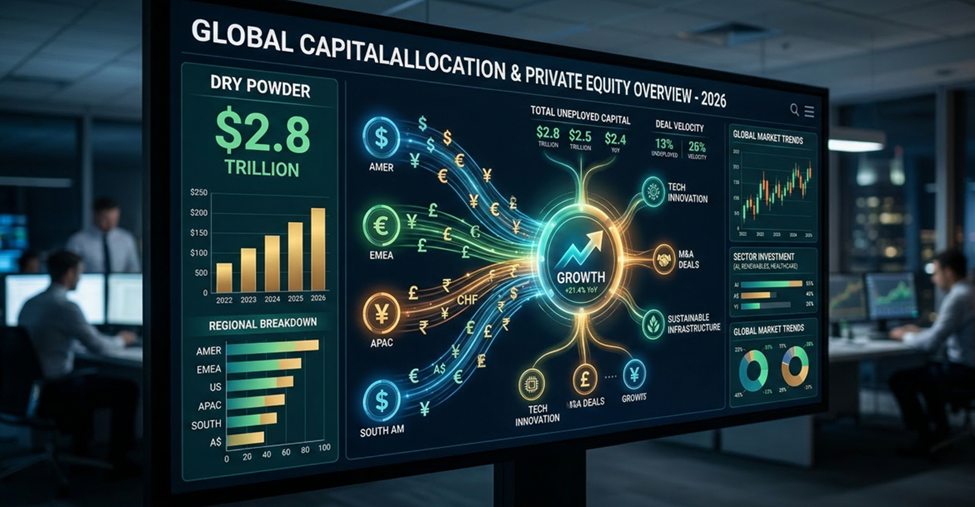
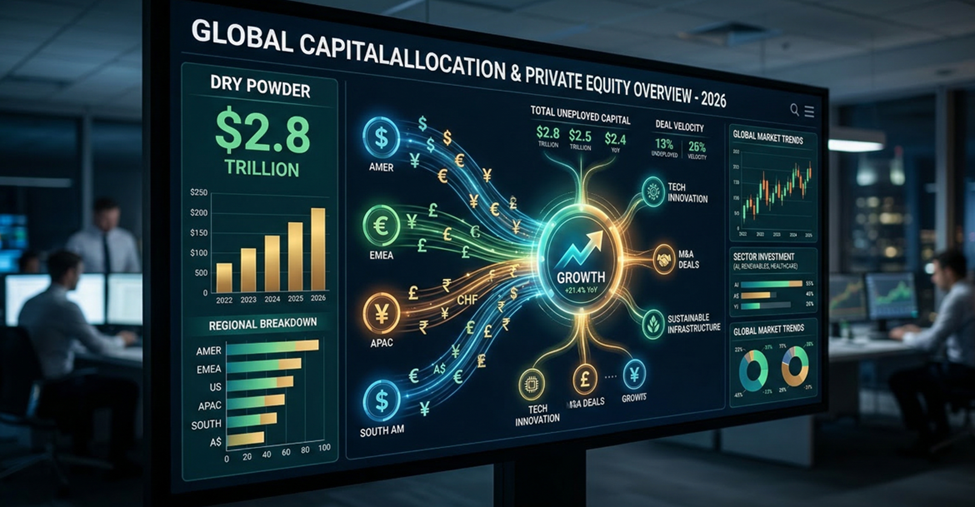
As corporate M&A has usurped the headlines, the Private Equity (PE) firms have a record dry powder of a whopping $2.8 trillion.
The Leveraged Buyouts Maturated to Partnership Capital
The traditional Leveraged Buyout (LBO) has developed in 2026. Massive debt-loading has been made risky due to high-interest environments. Rather, PE firms are using 40-60% of high-margin AI firms in Growth Buyouts. This gives the capital that the target has to scale as well as the PE firm to enjoy the Mergers and Acquisitions: Trends, Benefits, and Global Impact without excessive leveraging of their own balance sheets.
The emergence of Secondary Buyouts
There is an upsurge of PE-to-PE transfers. When the funds expire in their life cycles, they are selling assets that is AI-ready to bigger funds. This forms a secondary market which continues to ensure circulation of liquidity even at a time where the IPO window is semi closed. [Image Prompt: A digital dashboard of a professional high-contrast image depicting the metrics of Dry Powder and global currency flowing to a central node, being called Growth.
Navigating Cross-Border Transactions and Geopolitics
Friend-shoring is becoming the determinant of the global effects of M&A
The Strategy of the Shield and the Sword
M&A is turning into a geopolitical shield by companies, as it buys local companies in amicable jurisdiction to evade tariffs. At the same time they employ it as a kind of sword to gain access to the new markets such as India and Vietnam where organic penetration is prohibited by the complicated local laws.
Handling the Regulatory Drift
The major challenge in 2026 is the problem of “Regulatory Drift” in which a deal accepted in the US could be halted in the EU half a year later thanks to the alteration of the ESG (Environmental, Social, and Governance) or data sovereignty regulations. The present day deal-making necessitates a Regulatory Due Diligence step that is on par with financial audit. [Connection to Internal Post on Regulatory Compliance].
The Human Element: Post-Merger Integration (PMI)
It is impossible to discuss a blog on Mergers and Acquisitions: Trends, Benefits, and Global Impact without mentioning the reasons why deals fail. It is not typically the math that fails in 2026, it is the culture.
AI-Driven Cultural Mapping
High technology companies are currently employing an analysis of Organizational Network (ONA) as part of the due diligence. It is an AI-powered device that scans the communication patterns in the target company. The acquiring company will be able to guarantee the retention of key talent and the benefits of the merger in terms of culture are actualized instead of being misplaced in translation by identifying the hidden influencers.
The “Day 100” Benchmark
The critical period is still the initial 100 days. But this has been condensed in the high-speed 2026 market into the “First 30 Days.” The two most significant predictors of long-term synergistic success are rapid IT system integration and instant clarity about the leadership roles.

ESG as a Value Driver, Not a Checkbox
By 2026, the responsibility of ESG has ceased to be an additional marketing tool and became a valuation metric.
Decarbonization M&A
Stable energy and manufacturing companies are purchasing Clean-Tech startups in order to cut their carbon footprint in a short period of time. It is not only the case with optics: lenders in 2026 also have much lower interest rates on companies with high ESG scores. This economic advantage is one of the driving forces behind the present wave of M&A in the industrial world.
Labor Synergies and Social Impact
Another global impact is calculated by the influence of a merger on the work force. Offers that focus on up-skilling the employees of the target instead of the mass layoffs are gaining more positive ratings among the regulators of labor unions in Europe and South America.
Key Takeaways for Stakeholders (Expanded)
- Smart Infrastructure: It is not only about purchasing assets but also about purchasing data and algorithms controlling it.
- Regulatory Agility: Recruit regulatory specialists at the earliest stage of the process (Letter of Intent (LOI)).
- Culture is Measurable: ONA and AI tools will enable the quantification of cultural fit prior to the deal.
- Sustainability is Profitable: Buy a Target to enhance your ESG score now to attract cheaper capital.