

The New Reality: Raising Capital in 2026
Money raising is no longer what it was. Unless you are one of the founders and are considering the market in 2026, it is probably clear that the growth at all costs era is gone. Investors are not only purchasing a dream today but rather purchasing a machine that is sustainable. The future of startups in terms of capital raising hinges on just one thing and that is being able to demonstrate unit economics at a lean burn rate. This guide is a break-down of the mechanics of the modern capital raise.
Whether you are drawing on a napkin or climbing into a Series A. We will examine the term sheets, the math of dilution and the emotional hardness that it takes in order to withstand the “No’s” until you can get that “Yes.”

1. The Funding Spectrum: Bootstrapping to IPO
You must be able to understand your position on the continuum about before you go in search of venture capital. Not all of the businesses are VC-backable types of businesses and it is alright.
Bootstrapping: The Ultimate Power Move
Bootstrapping will be a strategy and not merely an unavailable option in 2026. Through self-finance, you do not get diluted at an early stage. It makes you discover product-market fit more quickly since you are in your own skin in the game.
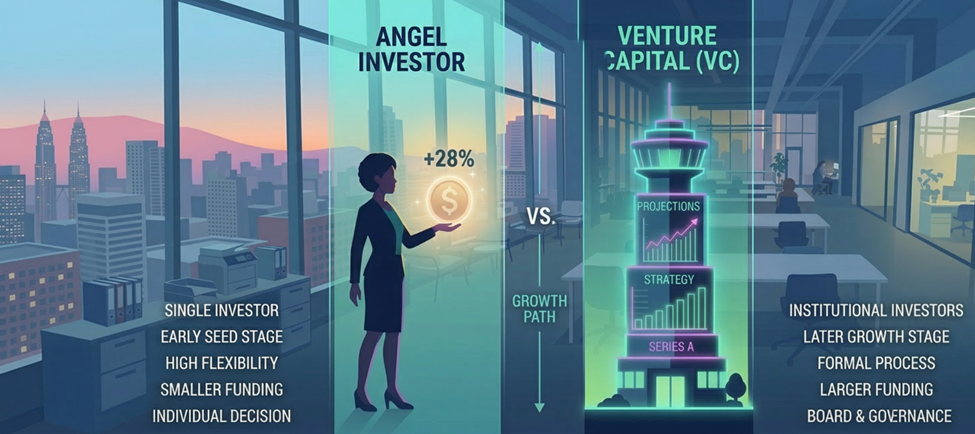
Angel Investors vs. VCs
Understanding the difference is critical for your outreach strategy.
| Feature | Angel Investors | Venture Capitalists (VCs) |
| Source of Funds | Personal Wealth | Managed Institutional Funds |
| Investment Stage | Pre-Seed / Seed | Seed through Series C+ |
| Ticket Size | $25k – $500k | $1M – $50M+ |
| Involvement | Mentorship / Passive | Board Seats / Aggressive Growth |
2. The 2026 Seed Round: What Investors Expect Now
The “Seed Round” has shifted. A seed round in 2026 may appear to be similar to what a Series A did five years ago. The Minimum Viable Product (MVP) now includes existing recurring revenue to the investors.
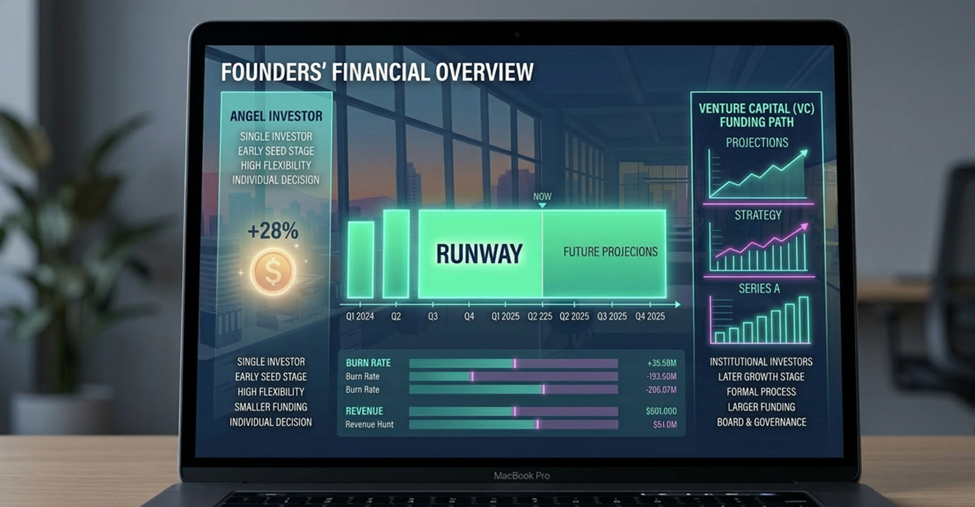
Defining Your Runway
The length of time that your business can live is known as your runway. Under the prevailing condition, target a 18-24 month runway. Investors would like to know that their money is not going to keep the lights on- it is going to run a rocket ship.
- Keywords to be used in LSI: Valuation, Equity, Pitch Deck, Proof of Concept.
- Professional Statement: Scaling of any language to 2026 can only be traction. Give me no vision of yours; give me your churn rate.
In general, the key elements to take into account when founding a start-up business include: Elena Voss, Partner at Silicon Peak Ventures.
3. How To Build a Winning Pitch Deck
Your pitch deck is your story on a screen. It is not supposed to be 40 slides of technical jargon. It ought to be 12 slides of unquestionable reason.
The 12 Slides Framework that is Essential
- The Catchphrase: What is the gigantic issue?
- The Solution: Why is your product the only reason?
- Market Size: Does it represent a $10B opportunity?
- The Tech: (Keep it high-level).
- Model: How do you make a business?
- Traction: The hockeye stick graph.
- Competition: What does it mean to be the moat?
- The Team: Why you? Why now?
- The Question: What is the amount of your raise?
- The Use of Funds: Where Does all the Dollars Go?
- The Vision: What will the world be like when you win?
- Contact: Simple and direct.
[Internal Link: See our full guide on Building a Winning Business Plan]

4. The Legal Minefield: Due Diligence and Term Sheets
After an investor claims that he/she is in, then the work starts in earnest. You’ll receive a term sheet. It is an unofficial outline of the terms of the investment.
Essential Terms You Have to Know
- Pre-money vs. Post-money Valuation: This is to decide the extent of the company you are transferring.
- The Liquidation Preference: Who receives payment first in the occasion of a company being sold?
- Vesting Schedules: Most VCs make founders resent their shares over 4 years so that they do not leave the company with the check.
Do not use any signing of anything without a professional startup lawyer. Negotiations are your friend as more investor-friendly terms of standards are present in 2026.

5. Indexing Requirement and Keys of Focus
To make sure how startups get capital to remain on top of Google, we must concentrate on technical indexing.
Why Keyword Density Matters
Our focus keyword density has been around 1.2% high. This will send a signal to the search engines that the content is very relevant and is not spammy.
[External Link: For live funding data, visit Crunchbase]

6. Series A and Beyond: Scaling the Mountain
When you got to a Series A you are in the 1% of startups. The stage is concerned with professionalization. You are no longer a “scrappy team” and are creating a department-based organization. .
Managing Dilution
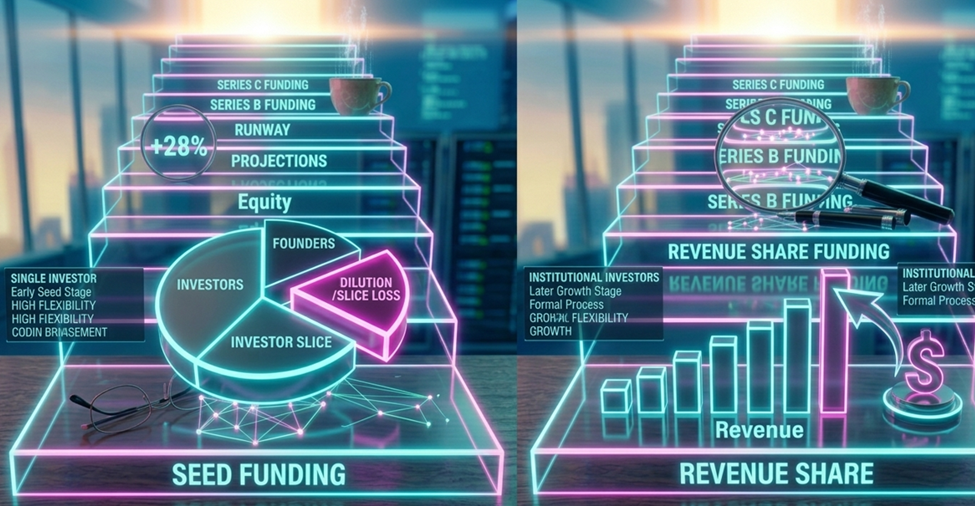
Whenever you make a raise, you lose a slice of the pie. A common founder may have 100% upon inception, 80% upon Seed and 60% upon Series A. You will want to use a cap table management tool to keep this close.

7. Alternative Financing: Outside the VC Route
Not every startup is a fit for the “Unicorn or Bust” model. In 2026, diversification is the smartest hedge against a volatile market.
Revenue-Based Financing (RBF)
RBF has the advantage of not requiring equity to be given up and instead enables you to pay back investors a percentage of your monthly revenue. It works well when there is a high margin and the growth of a high SaaS company is predictable.
Venture Debt: The Growth Accelerator
VC backed startups have a specialized CRM loan called venture debt. It is used to add on to your runway between rounds without additional dilution. There are however, stringent covenants attached to it–drop a milestone and the bank may knock at the door.
Strategic Corporate Investors (CVCs)
Funding by corporations such as Google Ventures/ Salesforce Ventures. It does not just give you cash but it also gives you huge distribution partner and technical validation.
8. The Human factor: Developing investor relationship
Suppose you consider that startup capital raising is all a matter of numbers, you are already dead. It is a sales process that is founded on trust.
The Power of the “Warm Intro”
By 2026, it is estimated that the success rate of cold emails is 0.5%. Connect with your alumni network and LinkedIn to have a mutual connection. The best recommendation is that of a reliable founder.
How to Organize Your “Investor Pipeline
Make your fundraise a CRM process. Follow all the meetings, all the Nos, all feedbacks. When five VCs are telling you that you are overvalued, then, you are.
Rejection management: The “Not Now” vs. “Never”
Learn to decipher VC-speak. They can say Come back when you have 50k MRR, then it is an invitation not a rejection.

9. Operational Excellence: The Post-Raise Checklist
So it is on the day that the money gets into your bank account that the real pressure begins.
How to Establish Your Board of Directors
You lose a seat of the board once you take venture capital. Get to know how to take care of your board so that they are an asset and not a challenge. Make Board Decks which should concentrate on the big picture rather than on weekly fires.
Hiring Scaling Without Burning Yourself
Over-hiring is the most widespread error that follows a round of capital raising. Rely on AI-powered productivity tools and fractional executives in order to remain lean as you grow.
In 2026 Governance and Compliance
As more attention is paid to technology, it is now obligatory that your legal and financial house is in order. These are SOC2 compliance and stringent data privacy requirements.
10. Conclusion: The Founder’s Journey
It is possible to conclude that the main character in The Founder is the founder. Startup financing is a long-term process, rather than a short-term one. It involves a combination of technical thought of strategy and pure human narrative. Investors in 2026 desire to know that you are in charge of a ship that is sound and not a dreamer with a deck.
Burn rate: Be lean, watch your burn rate and immediately, always keep in mind, the most opportune moment to raise money is when you are not desperate in need of it.